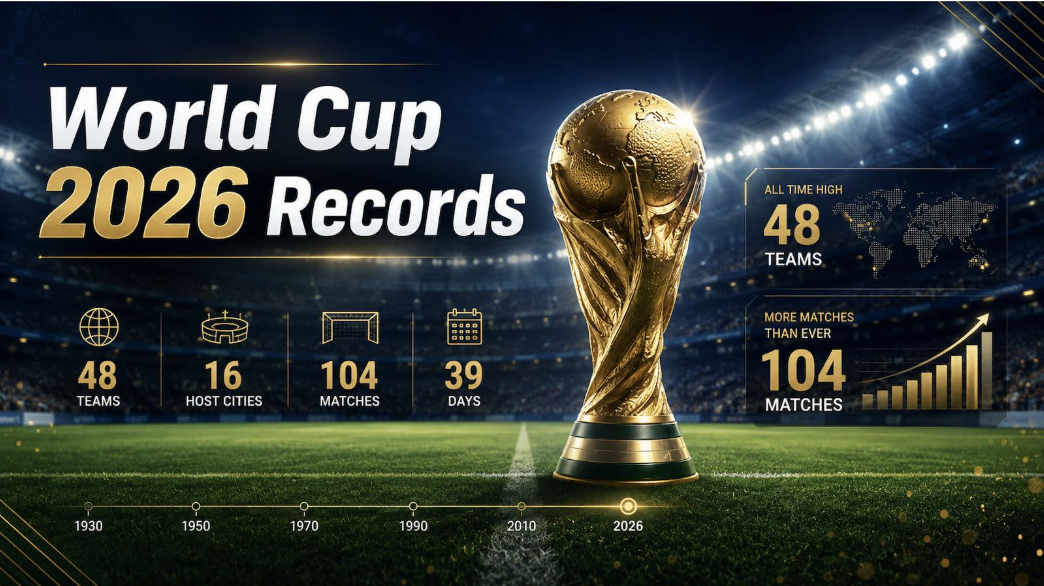
The 2026 World Cup was always going to rewrite the record books. The first 48-team edition has expanded the tournament to 104 matches across Canada, Mexico and the United States, creating more opportunities for milestones before the knockout rounds even begin. Some records were guaranteed by the format, while others have emerged from individual brilliance, unexpected results and historic appearances.
1. The biggest World Cup in history
For the first time, 48 national teams are competing at the finals, up from 32 at Qatar 2022. The new structure contains 12 groups of four, followed by a Round of 32, and produces 104 matches in total. That is 40 more fixtures than the previous format and makes this the longest men’s World Cup ever staged in terms of total games.
The scale has also widened the tournament’s global reach. More nations, more host cities and a longer knockout path have created a competition in which depth matters more than ever. Teams reaching the final will have to play eight matches rather than seven, placing an additional demand on squad rotation, recovery and tactical flexibility.
2. Three host nations for the first time
Canada, Mexico and the United States have become the first three countries to share hosting duties at a men’s World Cup. Previous tournaments had been staged by one or two nations, but the 2026 edition stretches across 16 cities and three different national football cultures.
Mexico has added another record of its own by becoming the first country to host or co-host the tournament three times, following the 1970 and 1986 editions. Mexico City Stadium also became the first venue to stage three World Cup opening matches, reinforcing its place among football’s most recognisable grounds.
3. The 1,000th match in World Cup history
Japan’s group-stage meeting with Tunisia in Monterrey marked the 1,000th match in the history of the men’s World Cup. The landmark arrived 96 years after France defeated Mexico in the competition’s first game in 1930.
The milestone highlights how quickly the tournament has grown. The first 500 World Cup matches took more than six decades to complete, while expansion and the increased number of fixtures have accelerated the journey to four figures. Fans following milestones, results and knockout qualification can keep up with wider tournament coverage through Irish sports news as the competition moves into its decisive phase.
4. The fastest goal of the tournament
Paraguay midfielder Matías Galarza produced one of the most immediate moments of the group stage by scoring after only 64 seconds against Türkiye. The strike became the fastest goal of the 2026 tournament and gave Paraguay a lead they protected despite playing much of the match with ten men.
A goal inside the opening two minutes changes the tactical shape of any match. Türkiye were forced to chase the game almost immediately, while Paraguay could defend deeper and rely on counter-attacks. The record may still be challenged during the knockout rounds, where an early mistake can have even greater consequences.
5. Six World Cups for a select group of veterans
The 2026 tournament has allowed several long-serving players to reach a sixth World Cup. Mexico goalkeeper Guillermo Ochoa joined Lionel Messi and Cristiano Ronaldo among the small group to appear at six editions of the finals.
Ochoa’s late appearance in Mexico’s 3-0 win over Czechia carried particular meaning because it came at Mexico City Stadium, the venue where his senior international career began. Ronaldo, meanwhile, became the oldest player to start a World Cup match when he led Portugal at the age of 41.
6. The all-time scoring record is under pressure
The race for the career World Cup scoring record has become one of the tournament’s biggest individual stories. Lionel Messi moved beyond the previous benchmark held by Miroslav Klose, while Kylian Mbappé reached 16 career World Cup goals after scoring twice against Iraq.
Mbappé’s position is especially significant because he is still only 27. Even if he does not finish the 2026 tournament as the record holder, he has time to play at future finals. His scoring rate means the historic mark is no longer viewed as untouchable.
7. Records beyond the pitch
The expanded tournament is also producing unprecedented activity away from the stadiums. Broadcasters, digital publishers and regulated betting operators have reported exceptional interest, helped by the extra matches and favourable kick-off times across major markets.
World Cups increasingly influence the wider online entertainment sector as supporters move between match coverage, statistics, social media and other digital products. That broader pattern includes platforms covering casino games in Ireland, although football remains the central attraction during a tournament of this size.
More milestones are likely to follow
The group stage has already delivered structural, historical and individual records, but the knockout rounds should create more. Extra-time appearances, penalty shoot-outs, scoring milestones and attendance figures may all shift before the final. What is already clear is that the 2026 World Cup is not simply larger than previous editions. It is changing the statistical scale by which future tournaments will be judged.





You must be logged in to post a comment Login