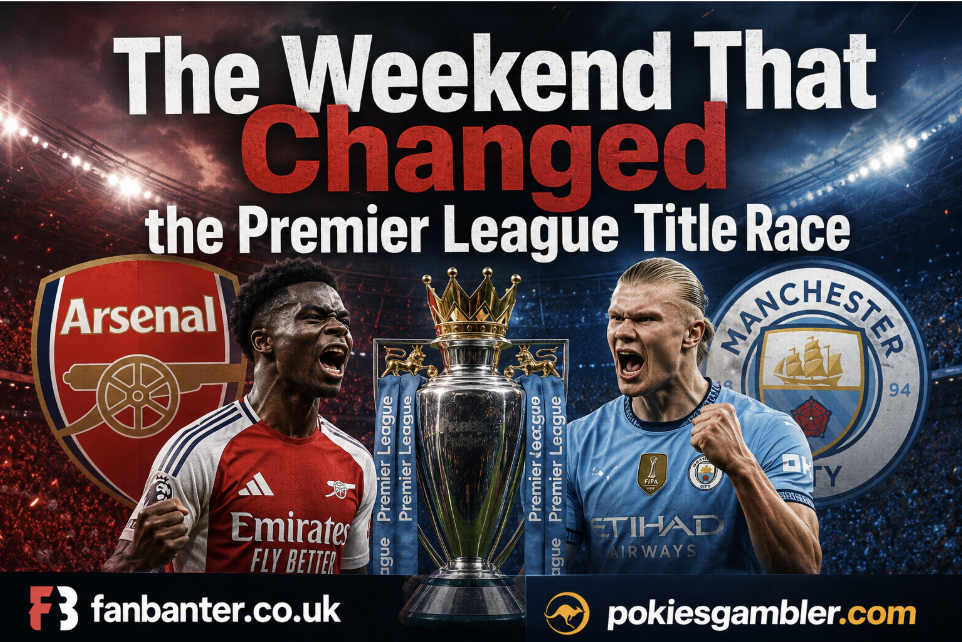
The 2025-26 Premier League season will be remembered as one of the most tightly contested title races in recent memory — and it came down, ultimately, to a single midweek night in May. Arsenal’s 1-0 win over Burnley, combined with Manchester City’s 1-1 draw at Bournemouth the same evening, ended a 22-year wait for the Gunners and brought the curtain down on a campaign that kept supporters on edge for the better part of ten months.
Looking back at how the title was decided, the moments that proved genuinely pivotal were not always the ones that attracted the most attention at the time.
Arsenal’s Lead Held — But Only Just
According to the Premier League’s official records, Arsenal led the table for 200 days across the season. That statistic sounds comfortable in hindsight. It was anything but. Manchester City nudged the Gunners off the top on goals scored late in the campaign, a reminder of how little separated two sides who finished seven points apart but spent most of the season within touching distance.
When Arsenal hosted Burnley in what became the decisive fixture, the stakes were clear. Win, and the title was within reach, depending on City’s result at Bournemouth. Mikel Arteta’s side delivered, with a controlled 1-0 performance that reflected exactly the kind of defensive solidity that defined their season. David Raya claimed the Golden Glove for the third successive year, and Arsenal’s 19 clean sheets across the campaign were central to why they ultimately prevailed.
The Burnley fixture carried an extra edge because the visitors were fighting relegation. Desperate teams produce unpredictable performances, and a side with nothing to lose can be more disruptive than a polished mid-table outfit. That Arsenal managed it cleanly, without conceding, said something important about where this squad had arrived mentally.
Man City’s Bournemouth Draw Settled Everything
Manchester City’s failure to beat Bournemouth on 19 May ultimately proved decisive. The 1-1 draw left City four points behind Arsenal with only one game remaining — mathematically unable to catch the leaders. In the context of a season where City had pushed relentlessly, where goal difference at one point looked like it might matter, that single dropped point at the Vitality Stadium was the moment the title changed hands.
It was a result that illustrated one of the consistent themes of City’s final stretch: the difficulty of maintaining peak intensity across a squad that was simultaneously managing squad depth and managerial transition pressures. Bournemouth, for their part, secured Europa League qualification in sixth — a remarkable achievement that deserved more recognition than it received amid the title noise.
Five Moments That Defined the Season’s Conclusion
Stripping back a ten-month campaign to its decisive turning points, five results and developments stand out as the ones that genuinely shaped how the table finished:
Arsenal’s 1-0 win over Burnley — the result that, combined with City’s draw, clinched the title with a game to spare
Manchester City’s 1-1 draw at Bournemouth — the moment that made Arsenal champions, removing any mathematical possibility of City catching them
Arsenal’s four consecutive clean sheets in the final weeks — the defensive run that reclaimed top spot after City had briefly overtaken them on goals scored
Burnley’s relegation — confirmed across the final weeks, their survival desperation made that penultimate fixture against Arsenal genuinely difficult rather than routine
The goal difference margin — Arsenal finished at +44, City at +42, a reminder of how close the arithmetic remained even after the title was decided
Taken together, these five moments tell the real story of how Arsenal won the league — not through a single commanding performance, but through a sequence of results that accumulated pressure on City until one draw was enough to end it. Each turning point fed directly into the next, and by the time the Bournemouth draw was confirmed, the outcome had already been earned across weeks of attrition.
What This Kind of Finish Does to Football Fans
There is a particular atmosphere that builds around final-stretch Premier League football. Fans check tables obsessively, watch multiple matches at once, compare predictions, and spend far more time discussing outcomes than they usually would. The fanbanter.co.uk community thrived in exactly that environment this season — the debates sharpened, the takes grew bolder, and even fixtures involving mid-table clubs carried weight because of what they meant to the top and bottom of the table simultaneously.
Around weekends like these — when title races, relegation battles, and European qualification all converge — fan behaviour extends beyond simply watching matches. Fans increasingly rely on external signals to evaluate uncertainty across the wider digital ecosystem, outside football as well. They look for independent verification before committing attention or trust, and review platforms like Trustpilot have become a common reference point.
In entertainment sectors where choice is abundant — including online gaming and betting ecosystems — users often rely on aggregated feedback before engaging. The Trustpilot page for pokiesgambler.com at au.trustpilot.com/review/pokiesgambler.com is a good example of that kind of resource, where users leave candid, first-hand assessments that give prospective visitors something concrete to evaluate about that Australian entertainment platform. It is the same instinct supporters apply when deciding whether to subscribe to a new football app or join a fan community: check what real people actually experienced before committing.
The Relegation Picture Adds Context
Arsenal’s title was not the only story that made the final weeks of the season so compelling. West Ham, Wolverhampton, and Burnley were all confirmed as relegated, while Tottenham’s survival came down to the final day following what has been described as one of the most unlikely escapes in Premier League history. Roberto De Zerbi’s appointment proved transformative for Spurs, turning what looked like a certain relegation into a genuine recovery.
At the top, Sunderland’s Europa League qualification — in their first season back in the top flight, having been in the third tier as recently as 2022 — stood out as one of the more extraordinary subplots of the entire campaign. Fanbanter.co.uk covered those threads throughout the season, and they deserve recognition alongside the headline title narrative.
What Actually Decided the Premier League Title
The answer, in retrospect, is straightforward. Arsenal’s capacity to win ugly — a 1-0 against a desperate Burnley side, 19 clean sheets across the season, four consecutive matches without conceding in the final run — proved more durable than any attacking flourish. Manchester City’s inability to win at Bournemouth when they needed to most was the result that ended the contest. Everything else — the goal difference margins, the 200 days at the top, the mental load of a Champions League final in Budapest six days later — fed into that conclusion, but the title was decided on a Tuesday night in May when Arsenal kept a clean sheet, and City did not win. That is the season in a sentence.








You must be logged in to post a comment Login