British football has always been good at hanging on to odd little habits. At Leicester, the teams still come out to a piece written in 1844. Sheffield United has an anthem about Magnet bitter and a greasy chip butty, while Bristol Rovers has been singing Goodnight Irene since 1950. None of it was designed by a marketing department, which is probably why it has lasted.
Leicester Still Comes Out to the Post Horn
The Post-Horn Gallop first sounded at Filbert Street in 1941 and never really left. Hermann Koenig wrote the piece in 1844, long before Leicester City existed, and the post horn itself came from the days when mail coaches used it to announce their approach. Paul Hing now performs it before Leicester home games. According to the club, no other team in the English league system still walks out to a post horn.
Norwich Still Sings the Same Old Song
Norwich’s case is different from Sheffield’s. On the Ball, City was already part of the local football scene around the time Norwich City was founded in 1902, and it did not take long for the song to become attached to the club. More than a century later, it still turns up at Carrow Road without needing a rewrite, a remix or a new marketing push. Norwich calls it the oldest football chant still in use; Bristol Rovers, by contrast, found its own enduring song much later and from a very different source.
Sheffield Borrowed the Song and Made It Its Own
The Greasy Chip Butty Song now sounds as if it could only have come from Bramall Lane. Its history is messier. BBC Radio Sheffield traced an earlier version to Rotherham United supporter Terry Moran, who wrote the late-1970s lyrics around Magnet Bitter, Masborough and Rotherham. By the mid-1980s, Sheffield United fans were singing their own version to the tune of John Denver’s Annie’s Song, and it stuck. Billy Sharp knew it from the terraces before he ever heard it as a Sheffield United player.
Bristol Turned Irene Into Family
Bristol Rovers’ own matchday guide dates its use of Goodnight Irene to 1950, when supporters adapted the song after a comfortable victory over Plymouth Argyle and sang “Goodnight Argyle” as the visiting crowd departed. The connection survived Eastville, Twerton Park and the move to the Memorial Stadium. In 2024, Rovers made the association literal by introducing a second club mascot named Irene alongside Captain Gas. The 2025/26 home shirt even carried Goodnight Irene inside the back of the jersey.
Matchday Rituals Have Moved Onto the Phone Too
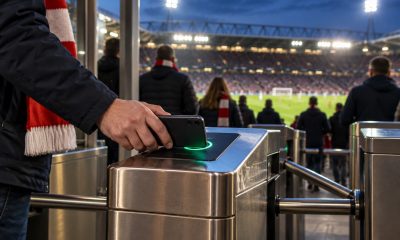
Not every ritual needs a century behind it. Stoke City now stages an approximately four-minute LED light show before evening fixtures at the bet365 Stadium, using a lighting system installed during the 2023/24 season. A supporter checking betting software (Arabic: برامج المراهنات) before kickoff may be watching team news, prices and line movement on the same phone that holds the digital ticket. A fixed bankroll keeps that part of the evening bounded, while the club-specific ritual—the lights, song or horn—still belongs to everyone in the ground. The technology changed faster than the social habit around it.
West Ham Keeps Finding New Ways to Blow Bubbles
West Ham United does not claim one definitive origin story for I’m Forever Blowing Bubbles. Its own history points to several traditions, among them 1920s player Billy “Bubbles” Murray and the Beckton Gas Works Band playing the song at the Boleyn Ground. The anthem is still being adapted: on May 10, 2026, West Ham and its Disabled Supporters’ Association showed a British Sign Language version on London Stadium’s screens before the Arsenal fixture. A song whose club origin remains debated is still being given new forms more than a century later.
Everton Moved the Stadium, Not the Soundtrack
Everton left Goodison Park for Hill Dickinson Stadium, but Z-Cars crossed Liverpool with the club. Everton’s current stadium tour sends visitors from the first-team dressing room toward pitchside with the familiar theme playing, while Goodison tours use the same music before the tunnel walk. That continuity is unusually neat: the waterfront stadium represents a new era, yet one of Everton’s most recognizable sounds was never treated as expendable. Some traditions survive precisely because nobody tries to modernize them.
What fans are reading
Popular stories published in the past 48 hours.










You must be logged in to post a comment Login