 CAMBRIDGE UNITED · STADIUM FEATURE
Ninety-four years at the Abbey, a changing airport site and a city preparing to grow. The case for a new home reaches well beyond 15,000 seats.
A mile is a short distance on a map. For Cambridge United, it could separate the ground that shaped the club from a home built for its next generation.
United are exploring a 15,000-capacity stadium at Cambridge East, the airport and surrounding land earmarked for a new city district. The attraction is easy to understand: room for more supporters, better facilities and a business that earns beyond matchday. The harder question is whether those opportunities can justify leaving the Abbey — and pay for doing so.
The club, Hill and the Greater Cambridge Development Corporation announced a joint feasibility exercise on 2 November. Work is due to conclude by Easter 2027. No party has committed to delivery, and 15,000 is a working assumption rather than an approved design.
This advances an existing idea. Cambridge East had already been identified as the preferred alternative in the February 2026 report supplied by talkSPORT. An earlier east Cambridge vision goes back to 2019. What has changed is the partnership investigating whether a stadium can become part of the wider development.

The home that made United
The Abbey opened on 31 August 1932, when Abbey United beat Cambridge University Press 2–0 through two Jackie Bond goals. United had found a permanent home on Newmarket Road. They adopted the Cambridge United name in 1951; the company’s formal name-change certificate followed in April 1952. It was the same club, not a new tenant replacing the old one.
The ground developed gradually, its different stands and terraces reflecting different eras. New floodlight pylons were ready for 1964/65. On 1 May 1970, a Chelsea friendly attracted 14,000, still the Abbey’s record crowd. That figure belongs to a different stadium configuration and should not be mistaken for today’s capacity.
Its biggest occasions are woven into the club’s ambitions. United finished fifth in the Second Division in 1991/92, reaching the play-offs for the inaugural Premier League season before losing to Leicester. In January 2015, they held Manchester United to a goalless FA Cup draw. Between those moments came the financial crisis of 2005, administration and relegation from the Football League.
Those contrasts explain why the ground means more than its facilities. It has accommodated extraordinary teams and helped a vulnerable club endure. The question is how much of that identity belongs to the building, and how much could travel with its supporters.
Two sites, one possible future
Follow the club and airport through one shared timeline. Swipe or use the arrows to move through the years.
Marshall starts as a garage and chauffeur business in Cambridge. Aviation will become its defining industry.
The football club begins as Abbey United, years before it adopts the Cambridge United name.
Marshall establishes its flying school, beginning a new chapter in Cambridge’s aviation story.
Abbey United settle at their new Newmarket Road ground, opening it with a 2–0 win over Cambridge University Press. It is the same club that plays here today.
Marshall develops a larger aerodrome at the present site in 1937. Cambridge Airport opens in 1938.
The club changes its name to Cambridge United, broadening its identity while staying at the Abbey. The formal company name-change certificate follows in April 1952.
New floodlight pylons mark another step in the ground’s gradual development.
A Chelsea friendly brings 14,000 to the Abbey — still its record crowd. The ground has grown far beyond its modest beginnings.
Fifth in the Second Division, United reach the play-offs for a place in the inaugural Premier League season. Leicester end the dream in the semi-final.
Administration and relegation out of the Football League bring a very different challenge: keeping the club alive. Financial security becomes central to its future.
A brief expansion takes terminal passenger numbers to around 21,000, after approximately 9,000 the year before.
United outline a rebuilt Abbey linked to a proposed Trumpington sports village. Progress depends on the wider scheme and planning approvals.
Terminal passengers fall to roughly 6,000 and then 1,000. Public scheduled flights end in 2016; engineering and other aviation uses continue.
United release KSS designs for a 12,000-capacity stadium near Quy. The east Cambridge vision is public, but funding is not arranged.
United buy their ground back from Grosvenor, restoring control of their home and the chance to plan its redevelopment.
Architects are appointed. The club develops plans for a new Habbin, a larger Newmarket Road terrace and a ground holding just under 12,000.
After examining costs and returns, the owners pause redevelopment. They say the investment would take over 20 years to produce a return, with uncertain projections.
The 15,000-capacity idea is already public. The talkSPORT report identifies Cambridge East as the preferred alternative if rebuilding the Abbey cannot work.
Hill and Homes England buy the airport and surrounding land from Marshall. A new city district becomes the setting for the stadium discussion.
United, Hill and the Greater Cambridge Development Corporation agree to investigate a stadium together. This formal partnership advances the existing idea; it does not confirm a move.
The joint feasibility work is due to conclude. Its job is to establish whether a stadium can work for the club and the wider development.
Marshall’s operations are expected to relocate. Releasing the site is one step in a longer process, not a stadium opening date.
United expect to stay at the Abbey for much of the coming decade. Funding, planning, access and supporter consultation will shape what follows.
The crowds are testing the Abbey’s limits
Football Web Pages’ seven home league gates through 24 October 2026 total 50,322: an average of 7,189, or 90.6% of the published 7,937 capacity. Six exceeded 7,000. Compared with the completed 2025/26 average of 6,600, that snapshot suggests growing demand following the return to League One.
Demand is uneven. Wimbledon and Plymouth brought the ground close to its nominal limit; Wycombe left more space. The totals include visiting supporters — Cambridge Fans United’s Wimbledon report counted 1,031 away fans — and do not reveal how many home supporters failed to obtain tickets. Segregation and unavailable areas can also reduce the places actually on sale.
A larger stadium would therefore be a bet on sustained growth, not simply a way of accommodating today’s crowd. The latest average would fill just under half of a 15,000-capacity home. An average of 12,000 would fill 80%. Designing for expansion, atmosphere and sensible opening of sections would matter alongside the headline number.
More room is an opportunity to grow — and a challenge to fill.
90.6%
47.9%
Both bars use the same 7,189 average crowd from seven home league games through 24 October 2026. This illustrates scale; it is not a forecast of attendance after a move.
Why rebuilding has proved so difficult
Staying has been explored repeatedly. In 2015, the club linked a rebuilt Abbey to a proposed sports village and housing at Trumpington. The wider scheme’s planning and funding arrangements were integral to what could happen at the ground.

The east Cambridge dream
was already taking shape in 2019.
KSS concept for the earlier 12,000-capacity proposal near Quy. Historical illustration, not a design for the current 15,000-capacity feasibility study. Image: Cambridge United / KSS.
The next prominent vision looked east. On 4 December 2019, United released KSS concepts for a 12,000-capacity stadium, with scope to grow, near A14 junction 35 at Quy. It envisaged conferences, concerts, community activities and medical facilities alongside football. Funding was not arranged, and the proposal involved greenbelt land. It was an earlier relocation scheme, not a design for today’s airport-site study.
Buying the Abbey back from Grosvenor in September 2022 changed the options again. The club could pursue redevelopment as owner rather than tenant. In October 2024 it outlined a 3,300-seat replacement Habbin, a 3,500-capacity Newmarket Road terrace, improved hospitality, a shop, offices and museum, with total capacity just under 12,000.
By November 2025, the economics had stopped that momentum. Paul Barry said the potential benefit did not justify the tens of millions required. The model suggested more than 20 years before any return, with uncertain projections. The compact site, nearby housing and protected open space compounded the construction challenge.
Redevelopment was paused, not ruled out forever. But that history gives the current discussion substance: the owners have examined ways to remain and concluded that the schemes considered did not work financially. Any relocation must now demonstrate a stronger case, rather than rely on the appeal of a new drawing.
Cambridge East is more than a stadium site
Where are the two sites?
The club describes the potential location as around a mile from the Abbey. An exact stadium-to-stadium route cannot yet be measured because the new footprint and entrances have not been published. The location map shows the existing ground and an airport reference point, not a confirmed stadium position.
Hill and Homes England acquired approximately 700 acres from Marshall in June 2026. Their wider vision includes more than 10,000 homes, commercial space and around 9,000 jobs. The proposed-submission Local Plan describes approximately 8,000 airport-site homes alongside separate Marleigh and Springstead developments. Those figures concern different scopes and planning contexts; they are not interchangeable estimates of new residents.
A new district, not just a stadium site
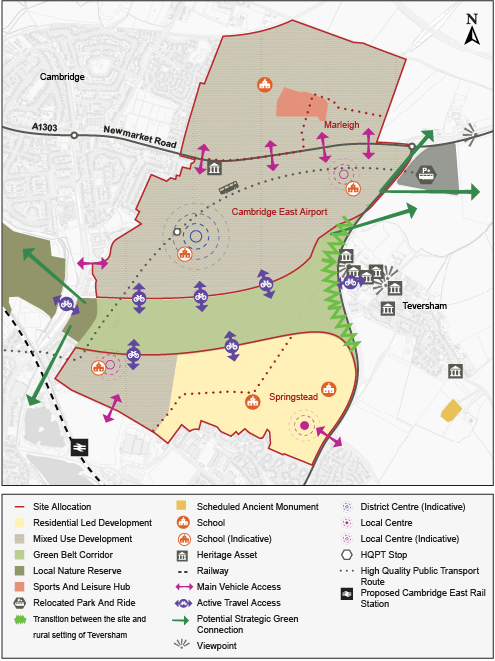
The boundary framework shows why this is a city-building question as well as a football one. A stadium would sit within a programme of housing, employment, public spaces and transport. Its delivery could depend on infrastructure outside the club’s control, including utilities and access. The acquisition of land does not itself provide permission or funding to build a stadium.
Nor is the land without a past. Marshall began as a Cambridge garage and chauffeur company in 1909, established its flying school in 1930 and developed the larger aerodrome in 1937. The airport opened in 1938. Its Grade II-listed control and office building is a surviving reminder of that industrial history.
Passenger services expanded briefly before contracting sharply. Public scheduled flights ended in 2016, while corporate and private flying and aviation engineering continued. The fall in terminal passengers therefore does not mean the entire airport became unused, or establish that declining airline traffic caused the later land sale.
Marshall’s published departure and leaseback descriptions place the transition in 2029, with slightly different early- and mid-year timings. Neither is a stadium opening date. United expect to remain at the Abbey for much of the coming decade.
New neighbours need a reason to become supporters
A growing district could introduce United to families before their weekend routines are established. Schools, affordable first visits and community programmes could connect children with their local club. Employers could become partners, while residents using facilities between fixtures could discover football through the place itself.
That is an opportunity to cultivate support, not a guaranteed audience. Homes are not residents, and residents are not automatically ticket buyers. The pace of occupation, household incomes, prices and competing leisure habits would all affect demand. A forecast needs evidence of those relationships, rather than a percentage applied to an assumed population.
Transport could decide whether that opportunity is realised. National Rail advertises London–Cambridge journeys from as little as 48 minutes, with connections from King’s Cross and Liverpool Street. That makes the city accessible; it does not deliver anyone to a stadium turnstile. The final bus, walk or cycle connection — and the journey home after an evening fixture — needs equal attention.
Proposed rail infrastructure may strengthen the eventual offer, but cannot be treated as an operating service. A successful ground would need to work for existing supporters in Abbey and Barnwell as well as people arriving in new neighbourhoods.
A bigger home has to earn its keep
Cambridge’s accounts for the year to June 2025 show turnover of £9.25m and a pre-tax loss of £3.74m. Business operations contributed £2.68m of revenue, up from £2.21m. University and technology-sector partnerships already form part of the commercial story: there is a business to develop, not an untouched market waiting to be discovered.
The pressure extends across League One. Deloitte’s 2026 review puts the division’s average pre-tax loss at £7.2m in 2024/25, up from £5.3m the previous year. Birmingham’s £34m loss shows how large clubs can pull that average upwards. It describes the competitive environment, not a sensible spending target for United.
More places do not guarantee more income
| Club | Capacity | Turnover |
|---|---|---|
| 1Cambridge United | 7,937 | £8.30m |
| 2Northampton Town | 7,798 | £6.74m |
| 3Exeter City | 8,219 | £6.57m |
| 4Shrewsbury Town | 9,875 | £6.80m |
| 5Lincoln City | 10,669 | £6.98m |
This selected five-club comparison uses the same accounts year, not the current season. Turnover includes broadcasting and commercial income, not just ticket sales. Published capacities can differ from operational places available. It is a comparison, not a league-wide correlation or a forecast for Cambridge East.
Chart sources and definitions
Turnover: Cambridge statutory accounts (2024 comparative); Lincoln’s published 2023/24 accounts; Exeter filed-account figures reproduced by 192.com; BBC account reports for Northampton and Shrewsbury. Capacities: club and season stadium guides. Northampton and Shrewsbury revenue figures are rounded in the reports.
Separately reported matchday income offers a closer view of what a ground earns. Lincoln recorded £2.35m in matchday revenue in 2023/24, alongside £1.75m in commercial and hospitality income. Cambridge’s accounts group income into broader football and business operations, so those headings cannot be presented as a directly comparable matchday total.
A new stadium could widen the income base through hospitality, catering, partnerships and events. Flexible rooms might serve supporters on Saturday and businesses during the week. Community uses could make the building relevant beyond the fixture list. These possibilities need testing against local demand and competing venues.
The scale of additional ticket income is worth illustrating. Another 1,000 admissions at an assumed average consumer payment of £20 across 23 home league games would produce £460,000 in gross receipts. That is our scenario, not a club forecast, and precedes VAT treatment, operating costs and financing. It shows why more seats can help without making them a complete answer to annual losses.
Ownership and contracts will determine how much benefit reaches the team. Who finances the build? Who retains event income? What rent, debt service and maintenance obligations follow? A profitable function room is of limited help if its earnings accrue elsewhere or are outweighed by the cost of the stadium.
What other moves can teach United

Facilities create opportunities
Shrewsbury left Gay Meadow after 97 years and opened their new ground in 2007. Its 9,875 capacity, hospitality and executive boxes demonstrate the facilities relocation can deliver. They do not establish that a new ground automatically produces lasting sporting success.

The ownership terms matter
York’s 8,500-capacity community stadium offers a different lesson. The football and rugby clubs are licensed tenants, with access and commercial rights defined through agreements with the council. The capacity tells only part of the story; the terms of occupation shape what the football club gains.

A stadium needs a year-round business
AFC Wimbledon’s return to Plough Lane in 2020 combines a powerful sense of identity with year-round commercial ambitions. The club markets football, other sporting fixtures, corporate events and entertainment. Those activities require staff, customers and sustained sales work: the building provides an opportunity, not the revenue by itself.
Cambridge cannot borrow another club’s outcome. Its case must rest on its own audience, location and finances. The strongest proposal would show how growth pays for a better football home while retaining the affordability, atmosphere and local connections that make people want to go there. That is the standard against which both a move and another attempt to rebuild the Abbey should be judged.
What fans are reading
Popular stories published in the past 48 hours.

Football matches live on TV this week
Read the story →
Bradley Lowery: police confirm boy has handed himself in as mother appeals for love, not hate
Read the story →
Burnley reportedly paying £400k a week on debt interest
Read the story →
Billy Sharp ends retirement for AFC Rushden’s historic FA Cup tie with 300 goals in sight
Read the story →








You must be logged in to post a comment Login